Smart digital marketing budget allocation comes down to 7 factors. These are business goals, target audience, past performance, competition, channel mix, seasonality, and tool and talent costs.
Get these right, and your budget grows your business. Get them wrong, and it just disappears.
Most businesses do not lose money by spending too little. They lose it by spending blindly. A $10,000 budget spent with discipline can outperform a $50,000 budget spent on guesswork almost every time.
This guide covers everything from setting your goals to knowing exactly when to adjust your spend, plus real budget examples by business type.
What Is Digital Marketing Budget Allocation?
Digital marketing budget allocation is about splitting your total marketing spend. You distribute it across channels like SEO, paid ads, email, and social media. This depends on your goals and past results.
It’s not the same as your overall digital marketing budget. That budget is just the total amount you plan to spend. Allocation is the strategy behind that number.
Two companies can spend the same amount but get very different results. This happens because one planned its budget carefully, while the other just guessed.
Marketing budget planning is the umbrella process. It involves three steps: setting the total budget, choosing your allocation, and leaving room to adjust based on new data.
How Much Should Your Marketing Budget Be?
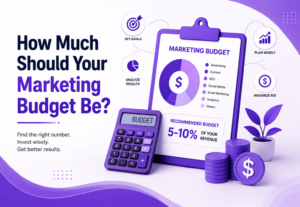
Your real number depends on your business size, stage, and industry.
Two major surveys track this every year. They do not fully agree. Gartner’s 2026 CMO Spend Survey puts average budgets at 7.8 percent of revenue, steady for three years. The Deloitte, Duke, and American Marketing Association CMO Survey shows a 9.0 percent increase for that period.
Why the gap? It comes down to methodology. Gartner surveys mostly large enterprises. The CMO Survey includes far more small and mid sized companies.
Treat 7–9% as a reference range, not a fixed target.
- Established small businesses: 5–10% of gross revenue
- New or fast-growing companies: up to 20%, since they need to build awareness before revenue catches up
Industry also shifts the number:
| Industry | Typical % of Revenue |
| SaaS and software | 11-22% |
| Consumer products (B2C) | 15-18% |
| Professional services | 7-12% |
| B2B products and services | 6-9% |
| Healthcare | 6-10% |
| E-commerce and retail | 5-10% |
| Manufacturing and industrial | 5-7.5% |
SaaS and B2C brands spend more because they compete hard on visibility and need repeat customers. B2B and manufacturing spend less.
Longer sales cycles and existing relationships do more of the selling than ads do. Healthcare sits in between, limited by compliance rules on which channels it can use.
The 7 Key Factors for Smart Budget Allocation
These seven factors work together. Skip one, and the other six get harder to get right.
1. Business Goals and Growth Stage
Your goals should decide your spend before anything else does. A brand new company fighting for attention needs a different split than an established brand protecting market share.
If your goal is brand awareness, you need reach. That means video, social, and content that introduces you to people who have never heard your name.
If your goal is lead generation, you need channels with clear intent signals, like paid search and retargeting.
Customer acquisition cost, or CAC, should guide how aggressively you spend to win a new customer. If your CAC is climbing faster than your customer lifetime value, that is a warning sign, not a reason to spend more of the same way.
A proper digital marketing strategy built around your actual goals fixes this before it becomes a bigger problem.
Why Is It Important to Align Your Marketing Budget With Business Goals?
Aligning your budget with business goals helps you avoid wasting money. This way, you won’t fund activities that look productive but don’t help the business grow.
Every dollar should tie back to a specific outcome, whether that is revenue, leads, or retention. Without that link, budgets get spent on whatever feels urgent instead of what actually matters.
2. Target Audience and the Buyer Journey
Not every customer is ready to buy the moment they see your ad. Understanding where your audience sits in the funnel, awareness, consideration, decision, or retention, tells you where to put your money.
A buyer persona is only useful if it changes what you do next. If your persona doc says your audience “values efficiency,” that should shape your ad copy, your content topics, and your channel choice. If it does not change any of that, it is decoration, not strategy.
B2B SaaS companies often spend about 38 percent of their budget on consideration. This is because buyers want proof before they make a commitment. E-commerce brands focus on awareness and decision stages. This is because purchases are quicker and more impulsive.
3. Historical Performance and Attribution
Check last year’s results before planning next year’s budget. Pull ROI and ROAS by channel. Some numbers will surprise you, a channel that looks weak on last touch might be doing real work earlier in the journey.
Four models explain most of what you’ll see:
- First touch. Credits the channel that introduced the customer.
- Last touch. Credits the channel that closed the sale.
- Linear. Spreads credit evenly across every touchpoint.
- Position based. Weighs the first and last touch more than the middle.
Tools like GA4, Triple Whale, and Northbeam now build a data driven model from your own numbers, no manual picking required. This is standard for anyone running ads across multiple platforms.
Simple picks by business type: Single channel: last touch. Multi-platform e-commerce: a data driven tool. Long cycle B2B: position based or linear.
No model is perfect. The goal is consistency, not precision, so you can spot real patterns.
4. Competitive Landscape
Ignoring your competitors’ spending is risky. Copying it blindly is worse.
Look at your competitors’ visible activity, their ads, their content output, their social presence.
This tells you roughly how loud the market is. If three competitors spend a lot on search ads, you have two choices. You can compete with them. Or you can find a channel where they aren’t active.
The share of voice matters more in crowded markets. If you’re a challenger brand in a crowded market, you may need to spend more than usual to stand out.
As a newcomer, trying to copy a market leader’s low-cost strategy often means staying unnoticed.
5. Channel Mix: Paid, Owned, and Earned Media
This is where you make most budget decisions. Here, your digital marketing budget can either succeed or quietly fail.
Getting SEO and email marketing right early usually pays off more than any other channel decision.
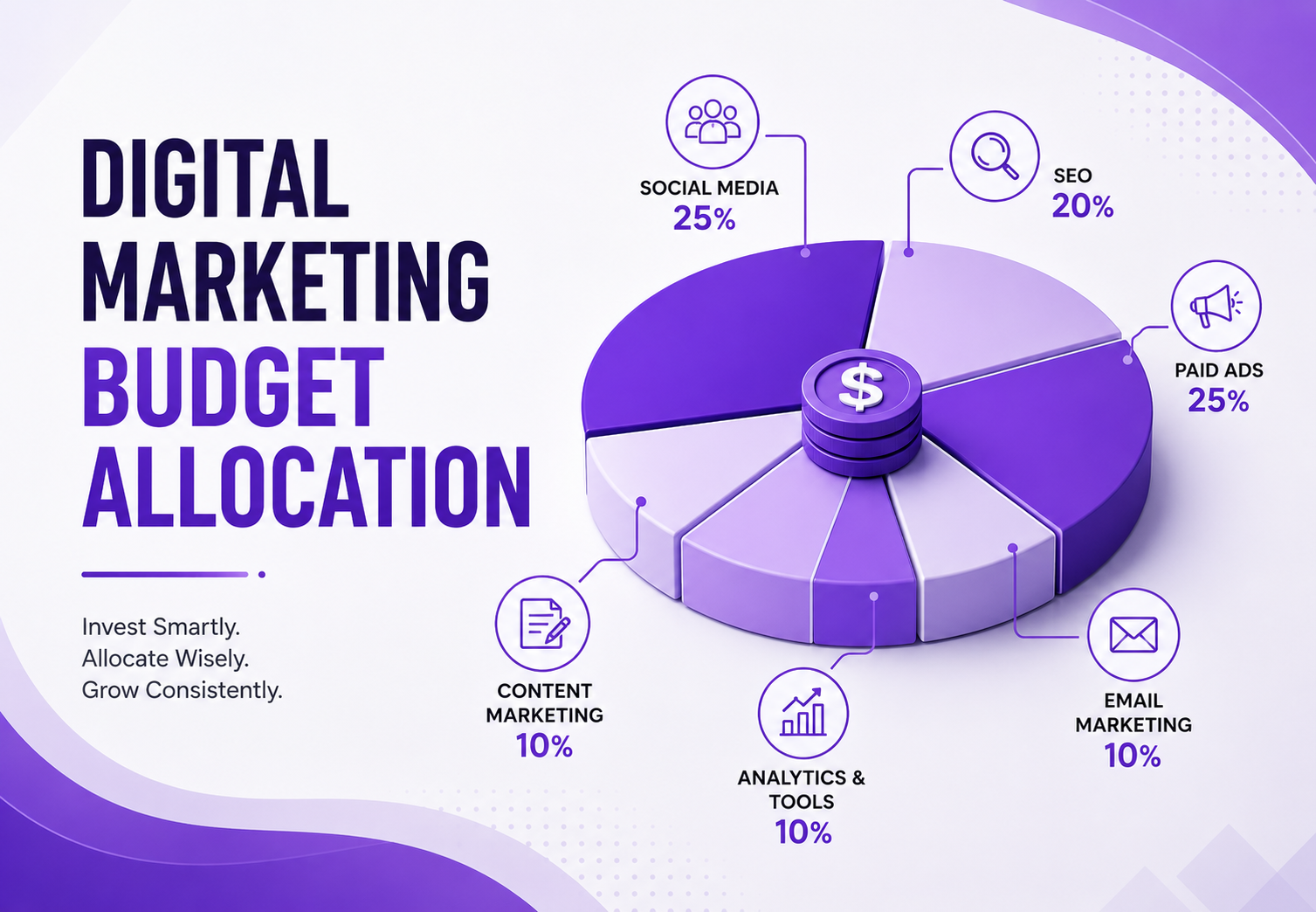
Here’s a simple starting benchmark based on common digital marketing trends. Use it as a reference as actual splits can differ a lot by industry and reporting source.
| Channel | Typical Budget Share | Why It Earns This Share |
| Content marketing and SEO | 25-30% | Compounds over time, drives organic traffic long after publishing |
| Email marketing | 15-20% | Highest documented ROI of any channel, often 20:1 to 40:1 |
| Paid search | 10-15% | Captures high-intent buyers actively searching |
| Paid social | 10-15% | Builds awareness and supports retargeting |
| Video marketing | 10-12% | Builds trust, explains complex products well |
| Tools and technology | 8-10% | Powers automation, tracking, and personalization |
| Testing and new channels | 8-10% | Prevents stagnation, catches emerging opportunities early |
This table answers how to allocate marketing budgets across channels for most businesses, but adjust it based on your industry, your audience, and what your own data tells you after 90 days.
What Is the 70-20-10 Rule in Digital Marketing?
The table above decides which channels get funded, the rule below decides how much risk you take within them.
The 70-20-10 rule divides the budget like this:
- 70% goes to channels that work well.
- 20% is for new tactics with potential.
- 10% support experimental ideas that lack history.
It balances stability and growth. So, you’re not stuck relying on one channel. You can also feel free to try new things.
What Strategies Can Enhance Brand Awareness in Your Marketing Budget?
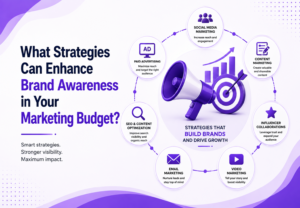
To boost brand awareness, shift more budget to video, paid social, and PR. These channels connect with people before they start searching for you. Sponsorships and influencer partnerships are effective, especially for new brands. They help build trust quickly.
6. Seasonality and Budget Pacing
Spending the same amount every month sounds fair. It is also one of the most common budgeting mistakes on record.
If your sales peak in November, boost your budget months ahead. This matters most when your sales cycle runs 60 to 90 days. Spend evenly, and you miss the window when buyers are actually researching.
How Do You Calculate Seasonality for Your Budget?
- Pull monthly revenue for the past two years. Mark your top 2 to 3 months.
- Count back by your average sales cycle length. That is when it needs to start climbing, not when the peak hits.
- A common starting point works like this. Increase spend by 20 to 30 percent in the lead-up months. Pull back by a similar amount in your slowest months to fund it.
Adjust the percentage based on how sharp your own seasonal swings actually are.
7. Technology, Tools, and Talent Costs
Marketing does not run on ad spend alone. Automation platforms, analytics tools, design software, and your team’s time all pull from the same budget.
A common and expensive mistake is paying for three tools that do the same thing because different team members set them up independently.
Audit your subscriptions every quarter. Most companies find 5 to 12 percent of their budget quietly leaking into overlapping software nobody fully uses.
Agency vs. in-house: a quick cost comparison
| In-House Team | Marketing Agency | |
| Typical cost | Salaries + benefits + tools (often $8K-15K+/month for a small team) | Flat retainer, often $2.5K-10K+/month depending on scope |
| Best fit | Companies with steady, long-term needs across many channels | Companies needing specialized skills without full-time headcount |
| Ramp-up time | Slower — hiring, onboarding, tool setup | Faster — existing processes and tools already in place |
| Flexibility | Harder to scale up/down quickly | Easier to adjust scope month to month |
| Institutional knowledge | Stays in-house long-term | Depends on retention and documentation |
Many growing businesses start with an agency or freelance mix for specialized channels (SEO, paid media) while building in-house capacity for content and brand, then shift the balance as budget and needs mature.
What Do Marketing Tools Actually Cost?
Tool pricing varies more than most budgets account for. A quick real world comparison:
| Tool Category | Budget Option | Cost | Higher Tier | Cost |
| Email marketing | Mailchimp Essentials | From $13/month | Mailchimp Premium | From $350/month |
| Email and CRM | HubSpot Starter | From $20/month | HubSpot Professional | From $890/month |
| Social scheduling | Buffer Essentials | From $5/channel/month | Hootsuite Standard | From $99/month |
| SEO research | Ahrefs Lite | From $99/month | Semrush Guru | From $250/month |
The jump from starter to professional tiers is steep across almost every platform, not just these two. Start on the lowest tier that covers your actual needs, and only upgrade when a specific feature you are missing is costing you real leads or time.
Budgeting Models Compared
Choosing how you build your budget matters as much as how you spend it.
| Model | How It Works | Best Fit |
| Percentage of revenue | Fixed percentage tied to projected revenue | Stable, established businesses |
| Objective-and-task | Budget built from the cost of specific goals | Startups with clear, measurable milestones |
| Competitive parity | Spend benchmarked against competitors | Challenger brands entering crowded markets |
| Zero based | Every expense justified from zero each cycle | Companies cutting waste or restructuring |
Most growing businesses start with objective-and-task budgeting, then shift to percentage of revenue once income stabilizes.
Worked Examples: Real Budget Breakdowns
SaaS startup, $10,000/month budget:
- Content and SEO: 30%
- Paid search: 25%
- Email nurturing: 20%
- Paid social: 15%
- Tools: 10%
Paid search usually shows results within 30 days. Content and SEO take 4 to 6 months to move the needle.
Local service business, $3,000/month budget:
- Local SEO and Google Business Profile: 40%
- Google Ads for urgent local searches: 30%
- Social media marketing for reviews: 15%
- Website maintenance: 15%
Google Ads can generate calls within the first week. Local SEO takes 60 to 90 days to stabilize.
Mid-market e-commerce brand, $40,000/month budget:
- Paid social: 25%
- Paid search: 25%
- Content and SEO: 20%
- Email and retention: 15%
- Influencer partnerships: 15%
Retention and email pay back fastest here, since the audience already knows the brand.
B2B service business, $6,000/month budget:
- Content and thought leadership: 30%
- SEO: 25%
- LinkedIn ads and organic: 20%
- Email nurture: 15%
- CRM and sales tools: 10%
Long B2B sales cycles mean this split rarely proves out before 90 days, often two full quarters.
One rule applies across all four. Give a reallocated budget one full sales cycle before judging it. Cutting a channel after two or three weeks means judging it too early.
Minimum Viable Spend Per Channel
Every channel has a floor. Spend below it, and you won’t get enough data to know if it works.
Rough minimums to start seeing real results:
- SEO: $500/month for real content and technical work
- Paid search: $500/month before algorithms can optimize
- Paid social: $300/month to get past the platform’s learning phase
- Email: $50/month for a decent platform, plus regular sends
Spreading $1,000 across five channels usually produces worse results than focusing that same $1,000 on one channel done well.
When Should You Reallocate Your Marketing Budget?
Do not wait for a channel to “feel” like it is failing. Watch for two clear signals instead.
Cost per acquisition rising over 25 percent for two straight months. Return on ad spend below breakeven for 60 days. Either one means cut that channel and move the money elsewhere.
Also check your spend against your current priority. If you shift from growth to retention, move the budget from paid ads to email and customer success content. Review this every quarter.
How Should You Budget for AI Search and GEO?
Set aside 5 to 10 percent of your content budget for restructuring old pages to answer questions clearly. Do not only create new content.
Search behavior changed fast. People now ask ChatGPT and Perplexity questions they used to type into Google. This shift is called generative engine optimization, or GEO.
Content built for AI visibility needs clear, direct answers, the same way this article does. Structured, well-sourced content gets pulled into AI Overviews far more often than vague, keyword-stuffed pages. Clear old content often beats vague new content.
Common Budget Allocation Mistakes
- Under-budgeting. Stretches your team too thin to make any channel actually work.
- Over-budgeting without a plan. Wastes money just as fast as spending too little.
- Ignoring attribution lag. Causes businesses to cut channels that were working, just slowly.
- Chasing every new platform. Pulls focus away from channels already proving themselves.
- Neglecting SEO and content. Costs more long term than any paid channel, simply because results take longer to show.
Conclusion
Smart digital marketing budget allocation is not about spending more. It is about spending with purpose. Review your numbers monthly, trust the data over your gut, and shift spend the moment a channel stops earning its place.
Start with the benchmarks in this guide, but let your own results write the final version of your budget.
Building that budget alone is doable. Building it right, faster, is easier with help. Get in touch with My Dedicated Marketers for a free consultation and let our team turn this guide into a working plan for your business.
FAQs
How do I create a simple marketing budget?
List your goals, choose channels where your audience spends time, assign each a percentage, and track results monthly. Adjust as real data comes in.
What is a good marketing budget for a small business?
Most small businesses budget 5 to 10 percent of gross revenue for marketing. Newer businesses often need 10 to 12 percent to build initial visibility.
How much should I spend on Google Ads vs Facebook Ads?
Favor Google Ads for high intent searches ready to convert, and Facebook or Meta ads for awareness and retargeting. A common starting split is 60 percent Google, 40 percent Meta.
How can I measure the effectiveness of my marketing budget allocation?
Track ROI and CAC by channel every month. A channel that returns more than it costs deserves more budget. One that does not should be cut and reallocated.
What are variable costs in marketing budgeting?
Variable costs include ad spend, sponsored content, and campaign-specific creative work. These scale up or down based on your goals and results.