Here’s what nobody tells you about the 7 Cs of digital marketing. Ask five agencies for the list and you’ll get five different answers. One swaps Convenience for Commerce. Another drops Cohesion for Channels. New marketers give up trying to memorize any of it.
That confusion costs real money. A campaign built on the wrong priorities burns the budget on content nobody reads. We’ve watched it happen more times than we can count.
This guide fixes that. We’ll walk through the most widely used version of the 7 Cs, explain why the list varies, and show you how to apply each piece. No filler. No recycled definitions. Just a digital marketing framework you can use this week.
What Are the 7 Cs of Digital Marketing?
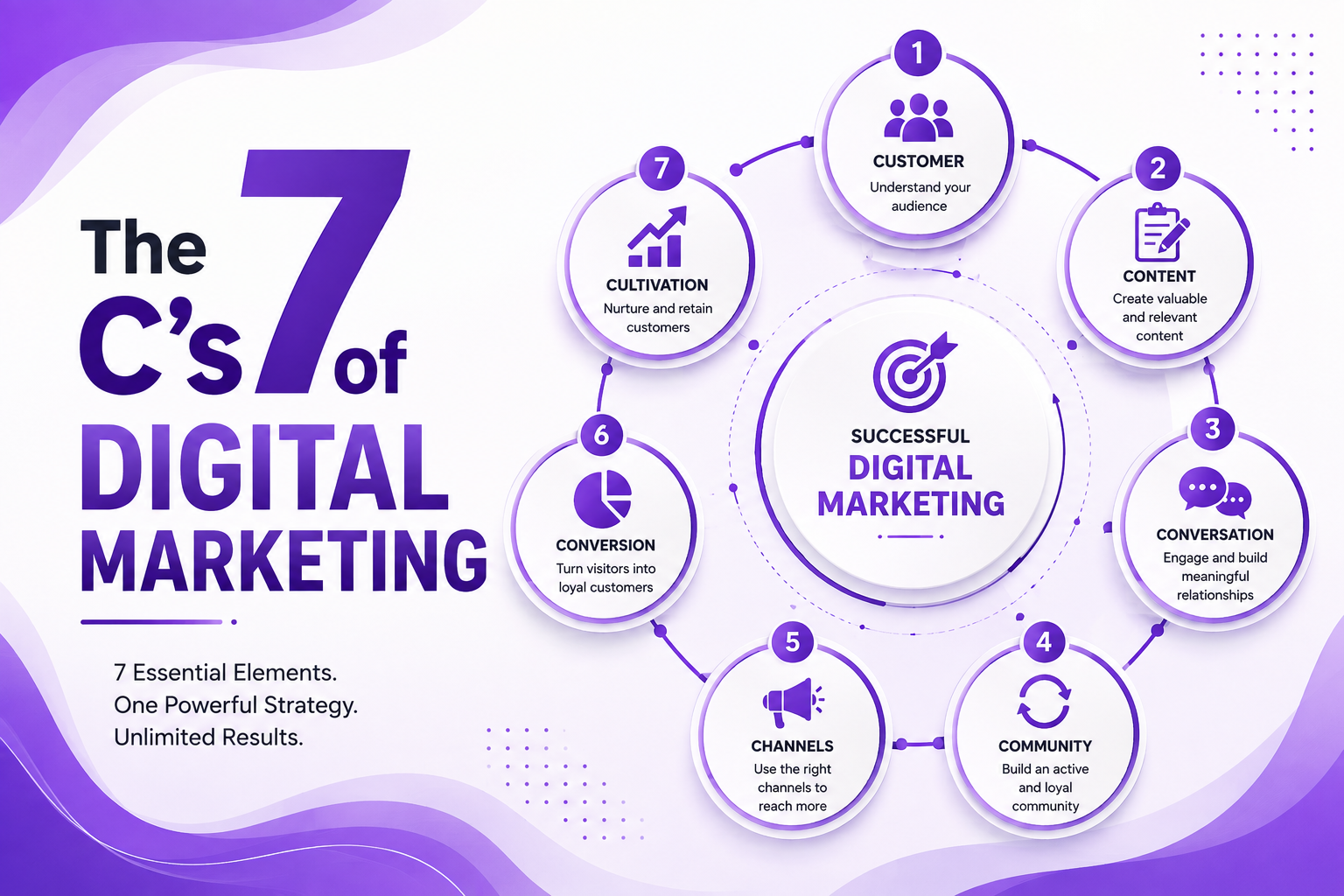
The 7 Cs of digital marketing are Customer, Content, Context, Community, Convenience, Cohesion, and Conversion. Together, they form a checklist for building a strategy that attracts the right audience and turns attention into revenue.
Think of it as a diagnostic tool, not a checklist you complete once. Every quarter, ask: are we still nailing all seven? Miss even one, and the whole strategy wobbles.
Why Do Different Experts List Different 7 Cs?
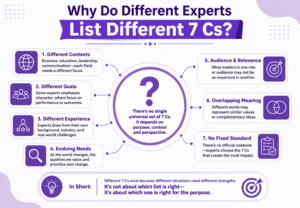
The 7 Cs of marketing framework has no single official source. It evolved from marketing classrooms and agency workshops, so different writers picked different words for overlapping ideas.
Some lists use Commerce instead of Conversion. Others use Channels instead of Cohesion. They’re describing the same territory with different signposts.
Our take: Customer, Content, Context, Community, Convenience, Cohesion, and Conversion is the version worth learning. It covers audience understanding, message creation, timing, relationships, ease of use, brand unity, and measurable results.
The 7 Cs of Digital Marketing Explained
1. Customer: The Starting Point, Not an Afterthought
Every strategy meeting should start with one question. Who are we actually talking to? Skip this step and everything downstream suffers.
We once reviewed a campaign built entirely around a product’s features, with zero customer research. The ad spend was solid. The targeting was guesswork. Cost per lead doubled in three weeks.
Building a buyer persona means going past age and location. Map out what keeps this person up at night. Map out what they type into Google Search at 11 p.m. That’s the real research.
How to apply it:
- Build two or three buyer personas from real customer interviews, not assumptions
- Track behavior in Google Analytics 4 to see what people do, not just say
- Update personas twice a year, since audiences shift fast
2. Content: The Vehicle for Every Message You Send
Content carries your brand into the world. Blog posts, videos, product pages, and social captions all count. More content is not the goal. Better-targeted content is.
A single blog post that answers a real question in depth will outperform ten shallow posts every time. Search engines reward depth. Readers reward honesty.
Good content marketing also earns backlinks naturally. When a page solves a real problem, other sites link to it unprompted. That’s the quiet compounding effect most beginners never see.
How to apply it:
- Answer one specific question per page instead of covering everything at once
- Use plain language a tenth grader could follow
- Update older posts through content optimization instead of always publishing new ones
3. Context: Delivering the Right Message at the Right Moment
Context is timing plus relevance. The same message can land perfectly or fall flat depending on when it appears. Picture two identical ads shown at different moments in someone’s day.
One shows up while someone is actively comparing prices. The other interrupts a video they’re watching for fun. Same product, same copy, wildly different results.
Search intent sits at the heart of context. Someone typing “what are the 7 Cs” wants a fast, clear answer. Someone typing “digital marketing agency near me” wants a phone number.
How to apply it:
- Separate informational keywords from transactional ones during keyword research
- Use search intent, not just search volume, to decide what to write
- Personalize email and ad content based on the buyer’s journey stage
4. Community: Turning Followers Into Advocates
A brand with a real community survives algorithm changes. A brand without one lives and dies by ad spend. That difference shows up fastest during a platform outage.
According to Tintup, 81.6% of consumers are more likely to try new products from brands with an active online community. That number should stop every marketing team in their tracks.
We’ve watched small brands outgrow larger competitors simply because customers felt like they belonged somewhere. A comment section that gets real replies beats a follower count every time.
How to apply it:
- Reply to comments within 24 hours, every time
- Create a space where customers can talk to each other
- Highlight user-generated content instead of only brand-produced posts
5. Convenience: Removing Every Point of Friction
Convenience decides whether someone finishes checkout or abandons the cart. It’s the quietest C, and often the most expensive one to ignore.
Page speed matters here more than most teams realize. A checkout that loads in three seconds feels instant. One that loads in eight feels broken, even if it technically works.
Mobile optimization falls under this C too. If a form is painful to fill out on a phone, visitors leave. They won’t complain. They’ll just vanish.
How to apply it:
- Test checkout and contact forms on an actual phone, not a resized browser
- Cut every unnecessary form field
- Offer multiple support channels, since not everyone wants to call
6. Cohesion: One Brand, Every Channel
Cohesion means your Instagram, email, and website all sound like the same company. Sounds obvious. Gets ignored constantly. We once audited a business whose social voice was playful while its website read like a legal disclaimer.
Visitors bounced between the two and felt something was off, even without naming it. Trust erodes fast when a brand feels inconsistent.
Cohesion also touches technical SEO. Consistent NAP consistency across directories and your Google Business Profile keeps local search rankings stable. Sloppy listings confuse customers and search engines alike.
How to apply it:
- Write a one-page brand voice guide and actually use it
- Audit NAP consistency across business directories quarterly
- Keep visual branding identical across every channel
7. Conversion: The Metric That Actually Matters
Every C before this one exists to support this final step. Conversion is where interest becomes revenue. A conversion isn’t always a sale.
It might be a form fill, a newsletter signup, or a downloaded guide. What matters is a measurable action tied to a business goal.
Traffic without conversion is a vanity metric. A site pulling ten thousand visitors with no leads is not winning. A site pulling eight hundred visitors with fifty qualified leads is.
How to apply it:
- Run A/B testing on your top three landing pages first
- Track conversion rate, not just traffic, every month
- Shorten forms wherever possible, since every field lowers completion
The 7 Cs vs. the 4 Ps: How the Frameworks Compare
| Framework Element | 4 Ps (Traditional) | 7 Cs (Digital-First) | Best Used For |
| Product focus | Product | Content | Digital content strategy |
| Pricing focus | Price | Convenience | User experience and checkout |
| Distribution focus | Place | Context | Timing and channel selection |
| Promotion focus | Promotion | Conversion | Measurable campaign results |
| Audience focus | Not included | Customer | Persona and search intent research |
| Relationship focus | Not included | Community | Loyalty and retention |
| Brand focus | Not included | Cohesion | Multi-channel consistency |
Methodology note: this table maps each 4 Ps category to its closest 7 Cs equivalent by core function, not a one-to-one translation. The 7 Cs add three categories the 4 Ps never addressed, because that model predates social media and search engines.
Mistakes We See Businesses Make Again and Again
Skipping the customer step and jumping straight to content creation. Teams get excited before confirming anyone wants it. That excitement rarely survives contact with real data.
Treating community as a vanity metric. Follower counts look nice in a slide deck. They don’t pay invoices. Engagement and retention do.
Ignoring page speed until conversion rate tanks. By the time most teams check Core Web Vitals, they’ve lost months of traffic. Prevention beats the fix every time.
Build customer research into every campaign kickoff. Track engagement, not just reach. Run a speed audit monthly, not annually.
How to Apply the 7 Cs of Digital Marketing to Your Business
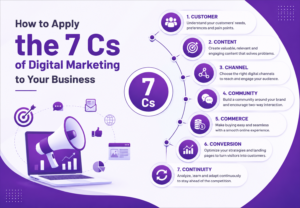
- Interview five current customers this month and write down their exact words
- Audit your last ten pieces of content against real search intent
- Map your buyer’s journey and flag every point of friction
- Revive one community space, even a simple Facebook group
- Run a mobile optimization speed test on your three highest-traffic pages
- Write a one-page brand voice guide your whole team can reference
- Pick one conversion metric and track it weekly, not quarterly
Controversial opinion, but someone has to say it. Most businesses don’t need a bigger marketing budget. They need to stop skipping Customer and Context before jumping straight to Content.
Conclusion
The 7 Cs of digital marketing aren’t a trend. They’re a working checklist for real strategy. Fix your weakest C first, then build momentum from there. Revisit this digital marketing framework every quarter as audiences shift.
FAQs
What are the 7 Cs of digital marketing?
Customer, Content, Context, Community, Convenience, Cohesion, and Conversion. Together they cover audience research, messaging, timing, relationships, usability, and results.
Which C of digital marketing matters most?
Customer. Every other C depends on understanding who you’re talking to first. Skip that step and the rest of the framework loses its footing.
How is the 7 Cs framework different from the 4 Ps of marketing?
The 4 Ps were built for traditional retail. The 7 Cs add digital-specific categories like Community and Cohesion. Those concerns didn’t exist before social media and search engines.
Do all sources agree on the same 7 Cs?
No. Some swap Conversion for Commerce or Cohesion for Channels. The core idea stays the same: understand your customer, deliver relevant content, and make it easy to convert.
How often should a business review its 7 Cs strategy?
Quarterly, at minimum. Customer behavior, search intent, and platform algorithms shift fast. A strategy built a year ago is often already outdated.