Google used to be the whole game. Now, ChatGPT, Perplexity, and Gemini answer questions before users visit websites. This shift has changed how brands are discovered online.
The best GEO tools help you keep up. Quick overview: Profound, AthenaHQ, Peec AI, Otterly AI, Writesonic, Semrush AI Toolkit, and Ahrefs Brand Radar.
This guide covers everything from features to pricing, each explored in full detail below.
Why Is It Important to Use GEO Tools in 2026?
AI overviews now appear in over 25% of Google searches, up from 13% a year earlier (Google Search Central). Only 16% of brands regularly track their AI search visibility, says a McKinsey CMO survey. Most are flying blind.
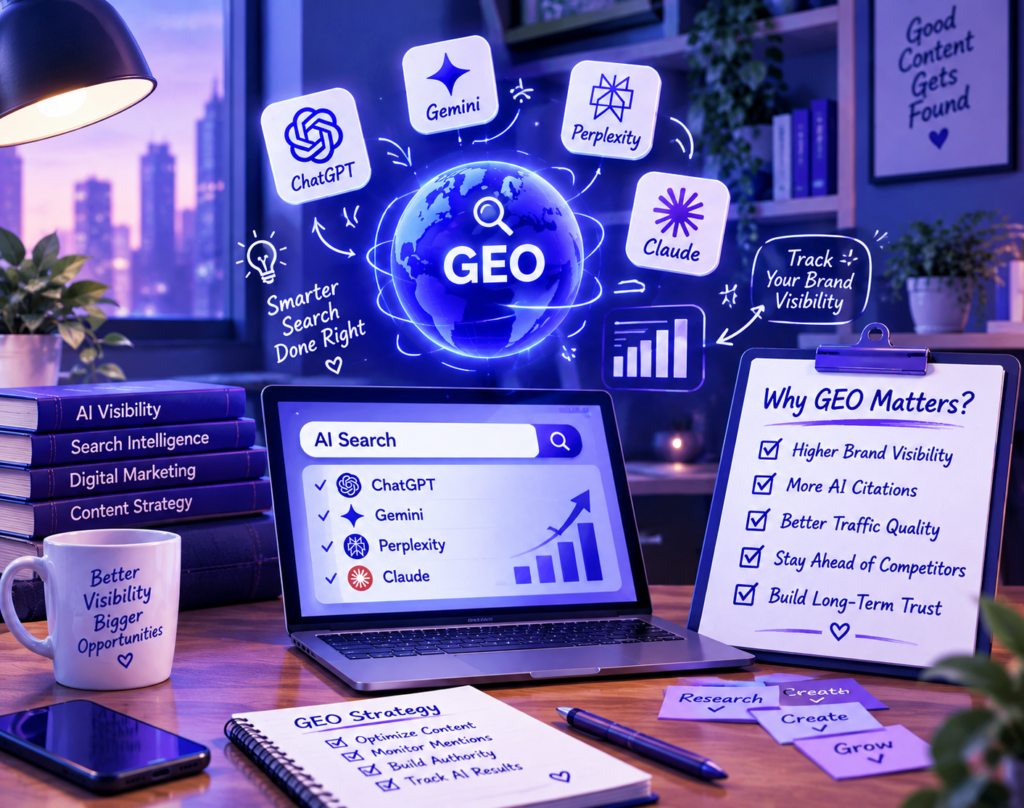
If AI engines never mention your brand, ranking on Google alone may not be enough. Semrush data shows that in Google’s AI Mode, 92-94% of sessions end without external clicks. Brand visibility now occurs within the answer itself, not through a click. That is why a modern digital marketing strategy has to include AI search visibility, not just traditional rankings.
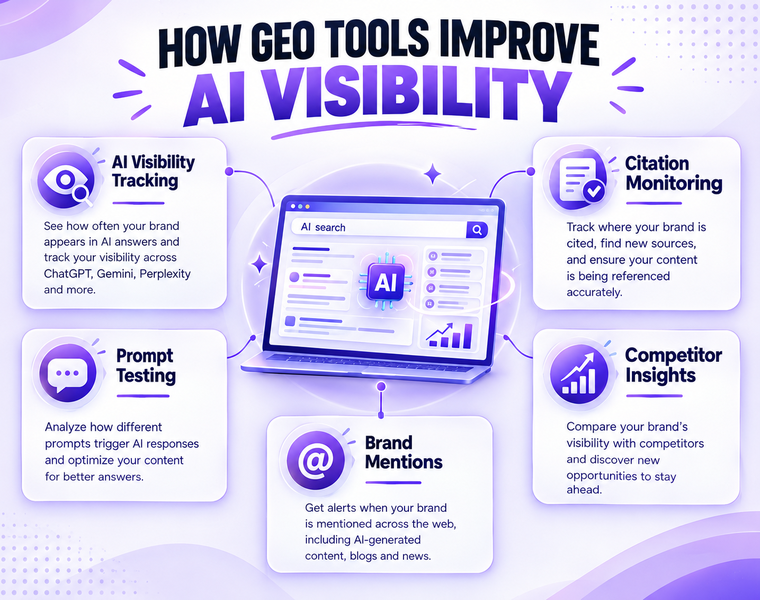
The best GEO tools help you spot that gap: Are you appearing in AI answers? How do people describe your brand? And which competitors are winning the citations you are missing?
The real dividing line between tools isn’t the dashboard. It’s whether the prompts they track are real or guessed. Some studies, like Conductor’s 2026 analysis, show that AI visitors convert nearly twice as much as regular traffic. So, check your status first.
What Are Generative Engine Optimization Tools?
GEO tools are platforms that monitor and report on how your brand shows up in AI-generated answers and, in some cases, help you improve them.
They don’t track page rankings. Instead, they look for mentions, citations, and recommendations from AI engines. Then, they turn that into data you can use. My Dedicated Marketers also provides digital marketing solutions for businesses looking to improve their online visibility.
Core Features of GEO Tools
Most platforms in this category combine a mix of the following:
- Visibility & mention tracking: This shows how often and where your brand shows up on ChatGPT, Gemini, Perplexity, Copilot, and similar platforms. It also includes which prompts trigger these appearances.
- Citation & source tracking: Which websites and sources AI engines pull from when they mention you or a competitor.
- Competitor benchmarking: Your share of voice against competitors, and who’s getting cited instead of you.
- Sentiment monitoring: Whether AI answers describe your brand positively, neutrally, or negatively.
- Reporting & recommendations: Dashboards to track progress, plus specific fixes to close visibility gaps.
Best GEO Tools 2026 at a Glance
Same category, but the prices vary greatly. Check each tool’s cost and what it includes before you commit.
| Tool | Engines Tracked | Starting Price | Free Trial |
| Profound | 9+ | custom for enterprise | Yes – 7-day trial |
| AthenaHQ | 11+ | $295/month | Yes – Free plan with $25 credit |
| Peec AI | 3 models | $95/month | Yes |
| Otterly AI | 4 AI platforms | $29/month | Yes |
| Writesonic | 3 AI platforms | $79/month | Yes |
| Semrush AI Visibility Toolkit | 4+ | $165.17/month | Yes – 7 days |
| Ahrefs Brand Radar | 6-7 | $199/mo per engine (plus a required base Ahrefs subscription) | No |
Top 7 Generative Engine Optimization Platforms for AI Search
Each tool outlined below follows a consistent format, making side-by-side comparisons simple. Each entry covers key features, pricing, and best use cases, so you can quickly see which option fits your needs.
Profound
Best For: Large enterprise brands with a full-scale AEO program. This includes B2B and B2C companies that have dedicated SEO/GEO teams. They should have a budget for custom pricing and need to connect AI citations to traffic, leads, or revenue for stakeholder reports.
Key Feature: Real front-end tracking built on more than a billion actual user prompts, not API samples.
Pros: Deepest data quality in the category. Ties AI crawler activity to real traffic and conversions.
Cons: No transparent self-serve pricing for the full platform. Overkill for small teams.
Pricing: Starter plans from $99/month. The full enterprise platform is custom priced.
AthenaHQ
Best For: Teams needing automatic task assignment from visibility gaps. It’s perfect for lean marketing teams that lack the time to analyze dashboards. This tool tells them exactly what to fix next. It also includes revenue tracking for teams on Shopify or using GA4.
Key Feature: Action Center converts raw data into prioritized, trackable fixes.
Pros: Strong workflow automation. Revenue attribution through GA4 and Shopify integrations.
Cons: Credit-based billing makes monthly costs hard to predict. Prompt volume is estimated, not directly observed.
Pricing: Starts around $295/month on paper, but actual cost depends on credit usage. First month discounted to $95.
Peec AI
Best For: Teams that want a clear, reliable monitoring dashboard ideal for agencies and in-house marketers checking AI visibility daily and sharing screenshots as proof with clients or leadership. Unlimited seats on every plan make it a strong fit for bigger teams, too.
Key Feature: Daily tracking backed by screenshot audit trails.
Pros: Best-in-class dashboard clarity. Unlimited users on every plan.
Cons: Only three engines included by default. No content creation tools.
Pricing: Starting from roughly €85/month, scaling to around €425/month on the Advanced plan.
Otterly AI
Best For: Small teams and solo marketers trying their first GEO move. It’s great for businesses testing if AI visibility matters before investing a lot. They want daily monitoring without a steep learning curve or a big upfront commitment.
Key Feature: No-code setup with unlimited team seats on every plan, including the cheapest one.
Pros: Lowest credible entry price for daily monitoring. Fast, simple setup.
Cons: Gemini and Google AI Mode cost extra. Entry-tier prompt limits run out quickly.
Pricing: Lite $29/month, scaling to $489/month on Premium.
Writesonic
Best For: Content teams seeking GEO tracking with content production. This is perfect for teams that write articles. They can manage visibility tracking and content creation in one subscription. This way, they won’t need to juggle many tools and logins.
Key Feature: Article Writer combines research, competitor analysis, and drafting in one workflow.
Pros: Tracking and content creation live in one subscription. Free AI crawler analytics.
Cons: Steep price jumps between tiers. Entry tier tracks only one AI platform.
Pricing: Starter from $49-79/month. Higher tiers scale up to $399/month on the Growth plan.
Semrush AI Visibility Toolkit
Best For: Teams using SEO in Semrush. It’s ideal for marketers who prefer not to onboard a new platform or vendor. They want AI visibility metrics to align with the keyword and backlink data they use daily.
Key Feature: AI visibility data sits next to existing keyword and backlink data in one workspace.
Pros: No new vendor or login required. Easy to trial inside an existing account.
Cons: $99 per domain adds up fast for multi-brand teams. It covers only four to five engines.
Pricing: $99/month per domain.
Ahrefs Brand Radar
Best For: Teams conducting in-depth competitive research on AI citations. It’s ideal for SEO teams and analysts who want to check any competitor’s AI visibility quickly. You can use historical data without needing ongoing monitoring for each brand.
Key Feature: A prompt index built from hundreds of millions of search-backed queries, searchable on demand.
Pros: Massive historical dataset. Zero setup to research any competitor’s visibility.
Cons: Full engine coverage can exceed $800/month once add-ons stack. No execution layer once you have the data.
Pricing: $199/month per AI engine index, or $699/month for all engines, plus a base Ahrefs plan.
How to Evaluate a GEO Tool
A tool that only shows you a visibility score without helping you fix it is half a product. Look for:
- Real prompt data, not guessed keywords: Some tools sample actual AI conversations. Others reshape old SEO keywords into question form.
- Multi-engine coverage: Buyers ask Gemini, Perplexity, and Copilot, not just ChatGPT.
- Citation and sentiment tracking: Getting mentioned and getting mentioned well are different outcomes.
- Action features: A chart that says you’re invisible is a diagnosis, not a fix.
- Pricing transparency: A self-serve product hiding its price behind a sales call is a signal worth noticing.
- Compliance: In regulated industries,SOC 2 Type II determines if procurement considers the tool.
Free GEO Tools Worth Trying
Free doesn’t mean useless. It means a smaller sample. See our full breakdown of free GEO tools and their limits for a deeper comparison. Here’s what you get without paying, and where each one runs out.
| Tool | Free Tier Includes | Limitation |
| LLMrefs | 1 keyword tracked, unlimited seats | Very limited scope |
| Otterly AI | Free trial, 4 engines | Time-limited |
| Ahrefs | Free AI visibility checker | One-time snapshot, not ongoing |
Which Is the Best GEO Tool in 2026?
There isn’t one universal answer: the right pick depends on what you’re trying to solve first.
- Proving the channel matters? Start with a free tool or a $29/month tracker like Otterly AI. You’ll have real answers within a week without committing to a budget
- Need to close the loop between insight and action? Check out AthenaHQ or Profound. These tools turn visibility gaps into prioritized fixes, not just charts.
- Already live in Semrush or Ahrefs? Use their built-in AI visibility modules. This means less engine coverage, with no extra login required.
- Running a full enterprise AEO program? Profound provides top-notch data quality. It links citations directly to traffic and revenue. Custom pricing is available.
Tools only give you the data, though. If you’d rather have experts turn those insights into action, explore our digital marketing plans to see what fits your goals and budget.
Conclusion
Stop waiting for a dashboard to reveal what you already know. Your brand is missing from half the AI answers your customers see. One of the Best GEO Tools can show you that gap for free this week — no cost, no long setup, just a clear picture within days.
Pick one platform where your competitors are getting citations that you aren’t. Focus on fixing that first.
GEO is most effective when you view it as an ongoing measurement, not a one-time check. Don’t just check Google rankings once; regularly track your GEO performance using one of the Best GEO Tools that fits your budget and team size.
Ready to find out where your brand actually stands in AI search? Check your AI search visibility today. See which citations you’re missing and which competitor is winning them. Need a hand? Talk to our team at My Dedicated Marketers.
Frequently Asked Questions
Are GEO tools worth it in 2026?
Yes, for any brand that depends on being found online. About 92–94% of Google AI Mode sessions end without a click. However, visitors from AI usually convert at a much higher rate than regular organic traffic.
Is GEO only about ChatGPT?
No. Gemini, Perplexity, Copilot, and Google AI Overviews all shape purchase decisions. Research from Yext found only about 5% of AI citations overlap across ChatGPT, Perplexity, and Gemini.
Can a small business realistically use GEO tools?
Yes. Several tools start under $30 a month, and free options exist for a first check, so there’s no real cost barrier to getting started.
Does using a GEO tool mean you can stop doing SEO?
No. AI models still pull heavily from well-structured, authoritative web content. GEO adds a layer on top of SEO. It doesn’t replace it. Strong SEO services remain the foundation of AI visibility. See how GEO and SEO work together for the full breakdown.
Is it possible to do GEO without buying a tool at all?
Yes, on a small scale. You can manually ask ChatGPT and Perplexity your target questions and log the answers. It won’t scale, but it’s a free starting point.