To understand how to rank on SearchGPT, you need three things working together.
Your website should allow OAI-SearchBot to access its public content and should be discoverable through relevant search providers.
Your content must answer questions directly with a clear structure. Your brand also needs to appear as a trusted name across the web, not only on your own domain.
Get these elements right, and citations are more likely to follow. Skip any one of them, and you may remain invisible, regardless of how strong your Google rankings are.
Why ChatGPT Rankings Are a Distinct Problem From Google SEO
Ranking in AI search requires a different approach because visibility depends on whether your content is understood, trusted, and selected as a source.
Google ranks pages. ChatGPT and SearchGPT cite sources.
Google hands users a list of ten links. ChatGPT writes one answer and decides, sentence by sentence, whether your page earns a spot inside it. There’s no position two. Either you get cited or you don’t exist for that query.
The citation-vs-SERP divergence is bigger than most SEOs admit
Only about 12% of the URLs ChatGPT cites also appear in Google’s top 10 for the same query, according to Profound and Ahrefs research. 88% of the time, the source ChatGPT trusts isn’t one Google ranks highly.
I’ve watched mid-size SaaS agencies hand clients a Google-first content plan and call it AI search strategy.
It isn’t. It’s SEO with a new label glued on top.
Why this matters even if you already rank number one on Google
A SaaS client once asked me, “We’re already number one for this term, why isn’t ChatGPT mentioning us?” Ranking first on Google proves you satisfy Google’s algorithm.
It proves nothing about whether Bing has indexed you, whether your content is structured for extraction, or whether your brand gets mentioned enough elsewhere for a model to trust your name.
What Is AI SEO Called Now?
AI SEO is most commonly called Generative Engine Optimization, or GEO. Some practitioners also use Answer Engine Optimization, or AEO, which focuses specifically on getting cited in direct answer results.
Both terms describe the same core work: making your content easy for an AI model to find, trust, and quote. Traditional SEO still matters underneath all of it. GEO just adds a new layer on top.
See our broader breakdown of AI in digital marketing for how this fits into the bigger picture
How ChatGPT and SearchGPT Actually Decide What to Cite?
Understanding the machinery here changes how you write everything else.
Standard ChatGPT Runs on Training Data
Without web search turned on, ChatGPT answers from what it learned during training. Your presence in that training data depends on how often and how credibly your brand showed up across the internet at the time the model was built.
You cannot edit this after the fact. You can only build for the next training cycle by getting mentioned more, in more trusted places, starting today.
ChatGPT Search Uses Live Web Retrieval
When web search is active, ChatGPT fetches real pages in real time before answering. This mode leans on Bing’s index as its main data source.
If Bing has not crawled and indexed your page, this mode cannot find you, no matter how strong your content is.
What Actually Triggers a Citation
Four patterns show up again and again in citation research. Sources that other trusted sources reference get cited more. Content that matches the exact framing of a question beats content that only covers the general topic.
Pages with clear structure get pulled into answers far more easily than dense prose. And brands recognized as clear entities, with a defined category and audience, get named more often in recommendation queries.
Who Does ChatGPT Recommend?
ChatGPT recommends brands it sees mentioned often, in good ways, across the web. It does not read your homepage and judge you. It looks for patterns in what other sites already say about you.
Neil Patel tested this himself. He asked ChatGPT for ad agency recommendations. Then he had a statistician check 82 possible factors across 100 different questions.
Six factors stood out: brand mentions, review scores, keyword relevance, brand age, third-party recommendations, and general authority signals like social following.
Here’s the surprising part. Two of the four agencies ChatGPT picked for SEO work were not agencies at all. They were software companies. ChatGPT matched them anyway, based on how often they got mentioned, not whether the recommendation actually made sense.
That should worry you a little. It should also tell you what to focus on. Getting mentioned often, in the right places, beats being perfectly accurate. At least for now.
Factors That May Improve ChatGPT Search Visibility
Several technical, content, and authority signals can influence whether ChatGPT discovers, understands, and cites your website. Here are the most important factors to focus on.
| Ranking Factor | What It Means | Why It Works |
| Brand entity strength | Your brand exists as a recognized “thing” across the web, not just your site | AI models trust entities they can define clearly |
| Topical authority depth | You cover a subject from multiple angles, not one article | Signals real expertise, not a one-off post |
| Third-party citation co-occurrence | Trusted sites mention your brand near your category keywords | Strongest single signal found in citation research |
| Bing index presence | Your pages are crawled and indexed by Bing | SearchGPT retrieval depends directly on this |
| Structured, extractable content | Clear headers, direct answers, defined terms | AI needs to pull clean facts, not decode prose |
| Content freshness | Updated regularly, with visible dates | Live retrieval favors recent, accurate information |
| Reviews and third-party validation | Ratings on G2, Trustpilot, industry directories | Builds trust signals the model can verify externally |
Third-party citation co-occurrence deserves a second look, because it flips how most people think about SEO.
Research from Profound found this factor correlated with ChatGPT mention rate at roughly 0.74, while traditional domain authority sat around 0.27.
Being talked about elsewhere now outweighs building links to yourself. That is a real shift, not a marketing slogan.
How to Rank on SearchGPT
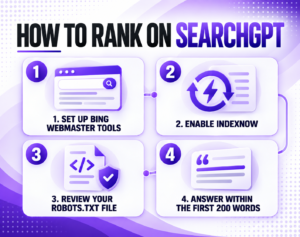
Ranking on SearchGPT starts with technical access, then moves to content structure. Skip the technical step and nothing else matters.
Why Bing Webmaster Tools Is Non-Negotiable
Most SEO teams have never logged into Bing Webmaster Tools. That single habit might be costing you more visibility than any content mistake you have made this year. Submit your sitemap there. Check your indexing coverage. Fix any crawl errors flagged in the dashboard.
Turn On IndexNow
IndexNow pushes new and updated content to Bing almost instantly, instead of waiting for a routine crawl. For fast-moving topics, this alone can shave days off your citation timeline.
Check Your Robots.txt File
Review your robots.txt file and check whether OAI-SearchBot is blocked. This crawler supports the discovery of public website content for ChatGPT search.
Review GPTBot and Bingbot separately because each crawler serves a different purpose. Allowing access does not guarantee a citation, but blocking the relevant crawler can limit content discovery.
Answer the Query in the First 200 Words
Give readers a direct answer near the beginning of the page. This helps users quickly confirm that the content matches their question and makes the central message easier for search systems to identify. Save the nuance and detail for after that.
How to Do ChatGPT SEO
Doing ChatGPT SEO well means building around actual questions, not keyword lists.
Build a Prompt Based Content Architecture
Keyword research asks what people type into a search box. Prompt research asks what people actually say to an AI assistant. Those two things overlap less than you would guess. “Best CRM” is a keyword. “What CRM works best for a five person sales team on a tight budget” is a prompt. Write for the second one.
Implement the Schema That Matters
Add Organization schema to your homepage. Add FAQPage schema to any page with genuine questions and answers. Add HowTo schema to tutorials. This is not decoration. It is a direct signal telling the model exactly what your content contains.
Structure Every Page for Extraction
Use clear H2 and H3 headers. Break dense ideas into short lists. Define specific terms plainly the first time you use them.
Our guide on how to make SEO-friendly content covers exactly how this structure interacts with broader visibility across search platforms, not just ChatGPT.
Optimize for ChatGPT and Perplexity at the Same Time
The good news is these two platforms overlap heavily. Both reward structured, direct, well sourced content. Both weight recency.
Both pull from live web retrieval rather than a fixed index. Build one strong content architecture and you serve both platforms without doubling your workload.
How a Small Website Can Rank in ChatGPT Without a PR Budget
Here’s the part almost nobody explains clearly. This matters most if you are not a big, well known brand. See our full guide on digital marketing for small businesses for the broader strategy beyond just AI search.
Stop Competing on Broad Terms
Small sites cannot win broad searches. “Best accounting software” is a fight you will lose. “Best accounting software for a two person landscaping business in Texas” is a fight you can win. Nobody else bothered to answer it well. You just need to be the one who did.
A Real Example
A local plumbing client had no press coverage. Their Domain Authority was under 15. We stopped chasing broad terms completely. We answered the exact questions their customers actually asked. We claimed their Google Business Profile properly. We got them listed on three regional directories. That is all.
Within 10 weeks, ChatGPT started citing them for local plumbing searches in their city. No press release. No agency retainer. Just narrow focus and a few trusted local mentions.
The Playbook for Small Sites
- Claim every free listing that fits your business
- Get real reviews on platforms people actually check
- Join relevant Reddit threads with real answers, not sales pitches
- Build a complete LinkedIn and Crunchbase profile, even if it feels pointless
Every step here is free. None of it needs a press team.
How to Increase Visibility in ChatGPT Searches Through Brand and Entity Building
ChatGPT is more likely to recognize and cite brands with clear identities, consistent information, and authority across trusted sources. Building these signals helps connect your brand with the topics and comparison queries your audience searches for.
Own the Comparison Query Space
Buyers ask ChatGPT to compare options constantly. “How does X compare to Y” is one of the highest intent questions in the entire buying journey.
Write honest comparison content that admits where a competitor genuinely wins. Readers and AI models both trust content more when it is not purely self-serving.
Get Into the Default Categories ChatGPT Reaches For
“Best CRM for small teams” and similar categorical phrases get used constantly in AI answers. Get mentioned in third-party roundups using that exact language, not just on your own blog.
Build Real Executive Presence
If your founder writes genuinely useful posts, gets quoted in trade press, or speaks somewhere that generates written coverage, that expertise attaches to your brand in the model’s understanding of who is credible in your space.
OpenAI SEO vs Traditional Google SEO: A Direct Comparison
Traditional SEO and AI search share some foundations, but they discover, evaluate, and present information differently. This comparison shows how each platform approaches visibility.
| Factor | Google SEO | ChatGPT (Training Mode) | SearchGPT | Perplexity |
| Primary index | Google’s own crawler | Historical training data | Bing’s index | Bing plus live crawling |
| Main authority signal | Backlinks | Third-party mentions | Bing SEO strength | Structured, cited sources |
| Update speed | Weeks to months | Fixed until retraining | Near real time | Near real time |
| Content format that wins | Comprehensive pages | Widely repeated facts | Direct, structured answers | Direct, sourced answers |
| Best entry point for small sites | Long-tail keywords | Consistent niche mentions | Narrow local queries | Well-cited niche content |
The Volatility Problem: Why AI Search Rankings Shift Daily
Most agencies selling GEO services won’t tell you this. A citation you earn this week can disappear next week for reasons nobody outside OpenAI fully understands.
That’s not a reason to skip work. It’s a reason to check your citation status monthly instead of building one perfect page and walking away.
How to Track and Measure Your ChatGPT and AI Search Visibility
Why Standard Analytics Miss the Full Picture
Google Analytics only catches people who click a link inside a ChatGPT answer. It misses everyone who saw your brand named, remembered it, and searched for you directly three days later.
That gap is sometimes called the dark funnel, and it is bigger than most teams assume.
Set Up a ChatGPT Referral Filter in GA4
Open GA4 and go to Reports, then Acquisition, then Traffic Acquisition. Filter Session Source using a regex match for chatgpt or openai. This catches both the older and newer referral tags ChatGPT sends through.
Metrics Worth Actually Watching
Track your citation rate across twenty to fifty real queries in your category. Track your share of voice against named competitors. Track whether the sentiment around your brand in those answers is positive, neutral, or unfairly negative. Position matters too.
Being the first source named carries more weight than being the fifth.
Common Mistakes That Keep Websites Out of SearchGPT and ChatGPT
Avoiding the following mistakes can improve your chances of being discovered and cited.
Neglecting Bing SEO entirely
The single biggest mistake, repeated across almost every client who has never opened Bing Webmaster Tools.
Over-optimizing for keywords instead of natural, conversational intent
Keyword stuffing looks amateurish to a model built to understand meaning, not match strings.
Publishing “AI slop” instead of extractable, cited-worthy content
Models increasingly recognize content that adds nothing new to a topic they already understand.
Skipping schema markup and structured data
A free, fast, machine-readable trust signal that most sites still ignore.
Ignoring content freshness and update cadence
A page last updated three years ago competes against one updated last month, and freshness genuinely affects citation likelihood.
Conclusion
Learning how to rank on SearchGPT is not about discovering a secret formula or relying on luck. It comes down to getting the technical basics right, answering real questions clearly, and earning genuine mentions across trusted websites.
None of this is overly complicated. However, many teams ignore it because it differs from traditional SEO, so they continue using familiar strategies.
Start by checking your robots.txt file and Bing Webmaster Tools. Then choose one narrow question your ideal customer asks and provide the clearest, most useful answer available.
That single page, created properly, may teach you more about ranking on SearchGPT than any guide, including this one.
FAQs
How fast can you rank on ChatGPT?
Technical fixes work in days to two weeks. Content changes show results in four to eight weeks. Real authority takes three to six months to build.
How to rank your business higher on ChatGPT?
Keep your positioning consistent everywhere online. Earn mentions on sites ChatGPT already trusts. Focus on narrow categories before broad ones.
What is AI SEO called now?
Generative Engine Optimization, or GEO. Answer Engine Optimization, or AEO, is a related term for direct-answer citations. Both build on traditional SEO.
How do I build content that ranks in ChatGPT?
Answer one specific question clearly. Use direct headers and short paragraphs. Add real data the model can quote.
What is the ChatGPT ranking tool?
OpenAI has no official ranking tool. Third-party AI visibility platforms track citation frequency across ChatGPT and other AI search tools.