A customer searches for your service right now. Google shows three businesses. Yours isn’t one of them. That’s not bad luck. That’s a local SEO mistake quietly costing you a customer who is ready to buy.
Local SEO mistakes are small errors that can keep your business off Google Maps, the local pack, and AI driven search results. Problems include inconsistent contact details, an incomplete Google Business Profile, and a website that isn’t mobile friendly.
Each one is fixable. Most take less than an hour.
Why Does Local SEO Matter For Small Businesses?
Local SEO is important. When someone searches “near me” on their phone, there’s a 76% chance they’ll visit a business within 24 hours. This comes from Think with Google’s mobile search data. If you’re invisible at that moment, a competitor gets the call instead.
Local SEO is often overlooked. It’s not about search engines; it’s about being available right when someone needs you. If you miss that moment, the opportunity may slip away before you realize it.
Why Local SEO Mistakes Hit Small Businesses Harder Than Big Brands
A national chain can absorb a bad month. A family plumbing company cannot.
Large brands have marketing teams watching every listing, every review, every algorithm shift. A small business owner is doing local SEO between service calls, invoices, and everything else that keeps the lights on. One person can overlook missed details for months.
I’ve watched a bakery lose its top local pack spot because a delivery app listed the wrong closing time. Nobody noticed for six weeks.
That’s the real danger. Local SEO mistakes don’t announce themselves. They just quietly redirect your customers to someone else.
This guide is built for the owner doing this alone, not a marketing department. Each solution outlined below can be implemented using free tools and completed in an afternoon.
What Are The Top 8 Most Common Local SEO Mistakes To Avoid?
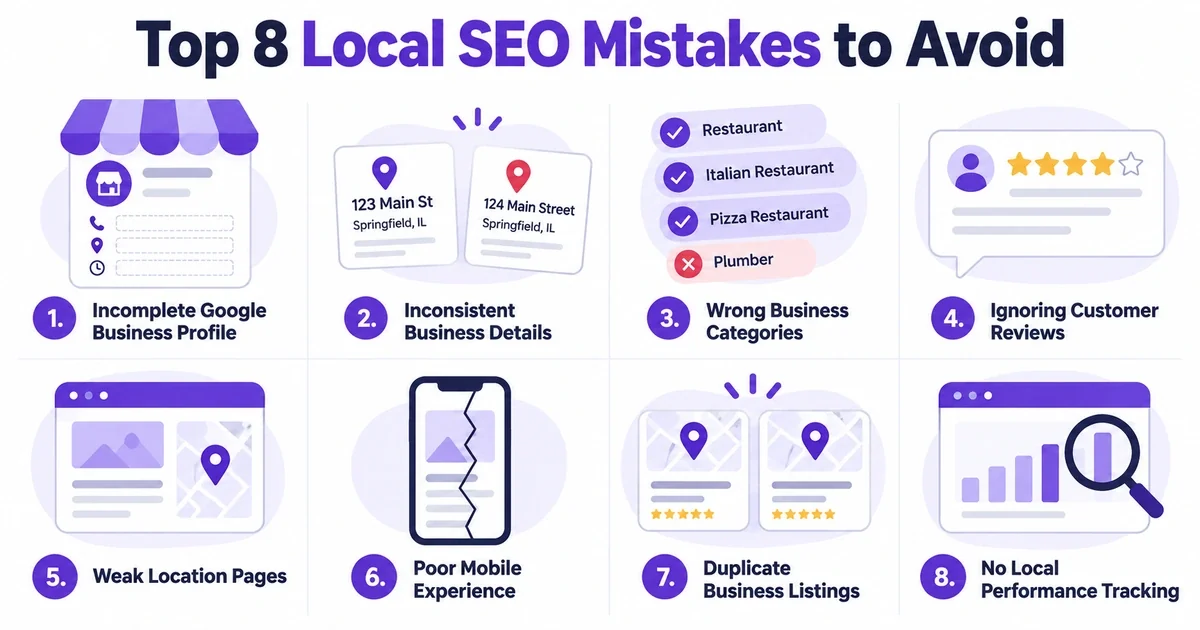
The most common local SEO mistakes are inconsistent business information, an incomplete Google Business Profile, generic content with no local keywords, ignored reviews, and missing schema markup.
Most businesses make at least three of these without realizing it. Let’s break down each one, what it actually costs you, and exactly how to fix it.
1. Inconsistent NAP
NAP is your business name, address, and phone number. When one directory says “Suite 200” and another says “Ste. 200,” Google reads that as a small trust gap, and citation consistency alone accounts for about 7% of local pack ranking weight, per the 2026 Whitespark/BrightLocal report.
The fix: Pick one exact version of your NAP. Match it everywhere: website, GBP, Yelp, Facebook, every directory.
2. Incomplete Google Business Profile
Your GBP is your digital storefront, and most owners claim it once and forget it. That’s costly. Complete profiles get 7x more clicks than incomplete ones, according to Google’s own data.
It matters even more now since GBP data feeds AI generated answers directly. 68% of US Google searches ended without a click in early 2026, per SparkToro, meaning many customers decide from your profile alone, without ever visiting your site.
The fix: Fill in every field: description, hours, services, photos, Q&A. Post weekly updates. Respond to reviews within 2 days.
3. Generic Content With No Local Keywords
Plumbing services tell Google nothing about location. “Emergency plumber in Coral Springs open Saturday” tells it everything.
This shows up two ways: no local keywords at all, or one page trying to cover every service area, which rarely ranks for any of them.
The fix: Work city and neighborhood names naturally into titles and SEO friendly content. Then build a dedicated page per city or major area you actually serve, referencing local landmarks and region-specific problems, and link it back to your core service pages.
Read more about: SEO friendly content
4. Weak Review Strategy
Reviews stopped being a nice-to-have years ago. They’re now a documented ranking signal, sitting behind only GBP signals and on-page content in most 2026 local ranking studies.
Here’s the part that surprises people. Star count alone rarely tells the full story anymore. A business with fewer, more detailed reviews mentioning specific services can hold its own against a competitor with a higher average and generic one-line comments.
Detail signals real experience, and real experience is harder to fake.
The fix: Ask every satisfied customer for a review. Make it easy with a direct link. Respond to negative reviews calmly and specifically instead of ignoring them. Silence looks worse than a mistake you owned and fixed.
5. Missing Schema Markup
Schema markup is code that explains your business to machines in plain terms: your name, hours, service area, and offerings, translated into a language search engines and AI tools can read instantly.
Skip it, and you’re asking AI systems to guess. ChatGPT, Perplexity, and Google’s AI Overviews rely heavily on structured data to understand who you are and whether you’re worth recommending.
Without it, you can be excellent and still invisible to the tools an increasing share of customers now use to find local businesses.
The fix: Add LocalBusiness schema with your NAP, hours, and service area. Add FAQPage schema to any FAQ content. Test everything with Google’s free Rich Results Test before publishing.
Read more about: ranking on SearchGPT
6. Mobile-Unfriendly Website
Most “near me” searches are conducted on mobile phones. If your site loads slowly or looks broken on mobile, Google notices, because Google now evaluates the mobile version of your site first, not the desktop one.
The fix: Run your homepage through Google’s PageSpeed Insights tool. Compress oversized images. Make buttons big enough to tap with a thumb, not a mouse cursor.
Test it yourself, on your actual phone, standing in your actual driveway with average signal.
Read more about: website loading speed
7. No Local SEO Tracking
You cannot fix what you never measure. Plenty of business owners do everything right and still can’t say what’s actually working, because they never set up a way to check.
The fix: Connect Google Search Console and Google Analytics. Check your Google Business Profile Insights monthly.
Track phone calls and direction requests, not just website visits. Traffic looks nice on a chart. Calls pay the bills.
8. Missing Local Citations And Community Backlinks
A link from your local chamber of commerce carries more local trust than a link from a random national blog.
Citations, even without a clickable link, still tell Google your business is a real, active part of the community.
The fix: Join your chamber of commerce. Sponsor a local event or youth sports team. Get listed in industry specific directories relevant to your field. These aren’t vanity moves. They’re trust signals search engines actually weigh.
How long does it take to fix local SEO mistakes?
Not every fix works at the same speed, so it helps to know what to expect before you start. Simple fixes like correcting your GBP category or fixing NAP errors often show results within days, sometimes as soon as Google re-crawls your listing or a directory update.
Content and backlink building usually take three to six months to show real ranking effects. It’s slower, but this kind of work compounds over time and tends to hold its position better once you get there.
When Your Basic SEO Is Broken, Local SEO Can’t Save You
Local SEO doesn’t exist in isolation. It relies on basic technical SEO. Any flaws in this foundation can hurt everything else.
Broken internal links confuse both visitors and search engines. A missing XML sitemap makes it harder for Google to find your pages at all.
Duplicate title tags across service pages waste ranking potential you already earned. Thin content, pages with barely 100 words, rarely earns a place in competitive local results.
None of these are glamorous fixes. All of them matter. A business with a flawless Google Business Profile and a broken website is still fighting with one hand tied behind its back.
Read more about: building an SEO strategy
How To Run Your Own Local SEO Audit In Under An Hour
You don’t need to hire anyone to find out where you stand. Grab a coffee and work through this.
- Search your business name and check every directory listing for matching NAP details
- Open your Google Business Profile and fill in any blank fields you find
- Run your homepage through Google’s PageSpeed Insights and note the mobile score
- Check whether your site has a dedicated page for each city or area you serve
- Test your structured data with Google’s Rich Results Test
- Review your last 10 customer reviews and confirm you responded to every one
Work through them in order, and don’t expect every fix to move the needle at the same speed.
Can I Do Local SEO Myself?
Yes, for most of the fundamentals. Claim your Google Business Profile. Fix NAP consistency. Ask for reviews easily. These tasks need no technical skills.
Technical tasks, like schema markup and site speed optimization, get tougher without coding skills. Many owners begin with the basics. They often seek help later when they are ready to grow beyond what one person can handle.
Common Local SEO Mistakes at a Glance
The full list in one glance what each mistake costs you, and how long the fix actually takes.
| Mistake | Real Cost | Typical Fix Time |
| Inconsistent NAP | Weakens citation and trust signals | Under 1 day |
| Incomplete GBP | 7x fewer clicks (Google) | 1 to 2 hours |
| Generic Content With No Local Keywords | Invisible for city-specific searches | 1 to 2 weeks |
| Weak review strategy | Lower trust, lower conversions | Ongoing |
| No schema markup | Invisible to AI search tools | 1 to 3 hours |
| Poor mobile experience | Lost mobile searchers, lower rank | 1 to 2 weeks |
| No tracking | Wasted effort, no direction | 1 hour setup |
| Missing citations | Weaker trust and authority signals | Ongoing |
Conclusion
Local SEO mistakes rarely feel urgent. They just quietly cost you the customer who almost called.
Fix your Google Business Profile this week. Clean up your NAP this month. Everything else can follow at your own pace. None of this requires a marketing degree. It requires attention, and now you know exactly where to point it.
Ready to see where your business actually stands? Run through the audit checklist above today or skip the guesswork and get SEO strategy from our team. The customer searching for you right now shouldn’t have to find someone else.
Frequently Asked Questions
What’s the difference between local SEO and regular SEO?
Regular SEO targets broad, non-location searches. Local SEO focuses on map pack rankings, “near me” searches, and Google Business Profile optimization for a specific service area.
Do I need schema markup if I’m a small local business?
Yes. Schema markup helps both traditional search engines and AI tools understand your business accurately. Without it, AI-generated answers are more likely to skip you entirely.
How much does local SEO cost if I hire help?
Reputable agencies usually charge $750 to $3,000 a month, depending on your market and competition. Be cautious of anyone promising top rankings for far less.
Can bad local SEO really lose me customers?
Absolutely. A complete and accurate GBP gets seven times more clicks than an incomplete one, based on Google’s data. One wrong phone number or missing field can cost more than a bad review ever would.
How do I improve my local SEO?
Start with your Google Business Profile, since it carries the most ranking weight and the fastest payoff. From there, work down the priority list in the audit checklist above, and revisit it every few months.