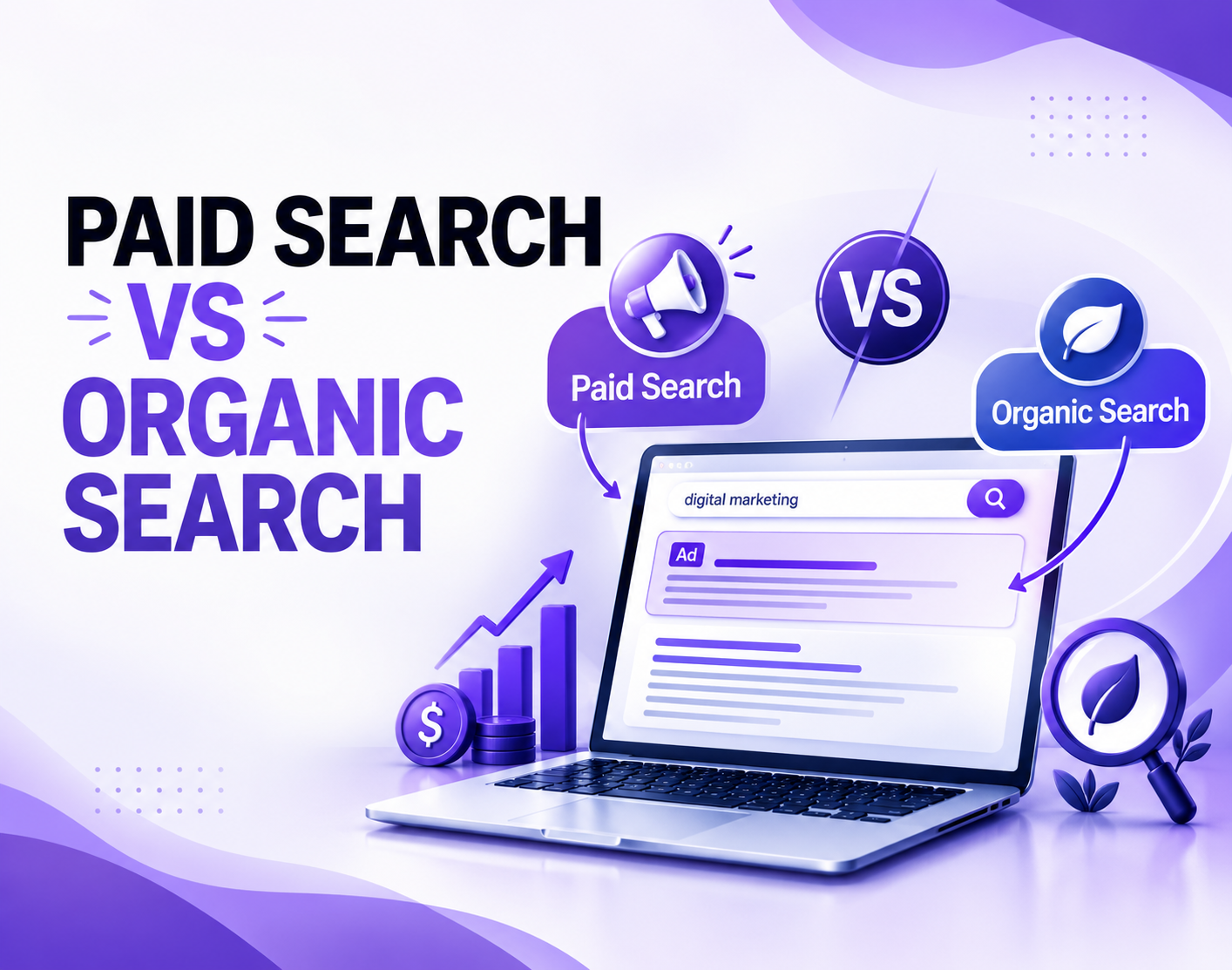
Paid search means paying for ads that appear at the top of search results, and it delivers traffic immediately but stops when your budget does. Organic search earns unpaid rankings through SEO and content. It takes months to build, but it keeps bringing in traffic at no cost per click.
The two channels pay you back in opposite ways. Ads send visitors the day you switch them on, then disappear when the budget does.
Rankings take months to build, but they keep bringing people in long after the work is done. If you want help picking the right mix, My Dedicated Marketers can map it out with you.
Below, we break down 10 key differences between paid search and organic search using current data and practical examples. Numbers shift by industry and market, so treat them as starting points, not promises.
What Are Organic Search and Paid Search?
Organic search means unpaid results. Google ranks them by relevance, quality, and trust. Some people call it natural search.
So what is organic search marketing? It is the work of earning those spots. That work covers content marketing, on page SEO, technical SEO, and backlinks. Many marketers also call this organic SEO marketing.
Paid search means ads. Advertisers bid on keywords in an ad auction. Google Ads and Microsoft Advertising run the biggest ones. Most ads use pay per click pricing, so you pay only when someone clicks.
A quick note on terms: search engine marketing (SEM) is often used as an umbrella for both SEO and paid search, though some marketers use it to mean paid search only. In this guide, the natural search vs paid search split is simply earned versus bought.
Organic search is a house you build. Paid search is a house you rent.
Paid Search vs Organic Search: Side by Side Comparison
Here is paid and organic search side by side.
| Factor | Organic search | Paid search |
| Cost model | Upfront work, no click fee | Pay per click |
| Time to results | Months | Hours or days |
| Longevity | Keeps working after launch | Stops when budget stops |
| Click trust | Earned | Labeled as advertising |
| Control | Limited | High |
| Best for | Long term demand | Launches and gaps |
How we built this table: we compared both channels on six factors. We checked each one against 2025 and 2026 data from WordStream, Ahrefs, and Seer Interactive. Your numbers will shift by industry, so treat them as a starting point.
Not sure whether SEO or PPC fits your goals? Explore our services to see how each channel can support your growth.
What Is the Difference Between Paid Search and Organic Search? 10 Key Differences
These ten differences decide where your money should go. We list them in order of impact.
1. Cost: PPC vs Organic
Paid search charges for every click. WordStream’s 2026 benchmarks put the average Google Ads click at $5.42. Legal clicks cost $9.87, while arts and entertainment clicks cost $1.63.
The organic vs PPC cost gap is real, but organic is not free. You pay writers, editors, and developers.
SEO costs vary significantly depending on competition, location, scope, and whether the work is handled in house, by freelancers, or by an agency.
Compare organic vs paid search ROI with one formula: ROI equals revenue minus cost, divided by cost. Judge cost per customer, not cost per click.
2. Speed: Days or Months
Ads can send visitors the day you launch. Organic needs patience. Ahrefs found only 1.74% of new pages reached the top 10 within a year, down from 5.7% in 2017. Ranking got harder, and nobody sent a memo.
Need leads this month? Run ads. Building for next year? Start your content now.
3. Longevity: Renting or Owning
Stop paying for ads and the traffic stops. A ranking page keeps working while you sleep. Ahrefs also found that 72.9% of the top 10 pages are over three years old. Trust and links pile up over time.
So the real choice is rent or equity. Rent gets you in the door fast. Equity buys you security, and you stop sweating every invoice.
Read more about building a winning SEO strategy
4. Trust and Click Behavior
Searchers can tell an ad from an organic result because ads carry a “Sponsored” label. Some people skip them, while others click when they are ready to buy.
Some users prefer organic results because they perceive them as earned rather than purchased, while ads can perform especially well on high intent transactional searches.
Google’s quality guidelines emphasize experience, expertise, authoritativeness, and trustworthiness, commonly referred to as E-E-A-T.
5. Targeting and Control
Paid and natural search differ most in control. Paid search lets you choose location, device, time of day, and audience. You can run retargeting for people who left your site without buying.
Organic gives you reach, not control. You cannot ask Google to show your page to left handed plumbers in Leeds. You can only answer their questions well.
6. Search Intent
Someone who types “emergency plumber near me” wants help now. Ads and the local pack win that search. Someone who types “why is my tap dripping” wants answers. Organic content wins there.
Long tail keywords often hide your best buyers. A software buyer might compare tools for six weeks. Organic content shapes that whole journey.
In paid search vs organic search, intent is the tiebreaker. Match the channel to the question, not to your mood.
Read more about SEO-friendly content that drives organic traffic.
7. Competition and Brand Terms
Check who holds page one. If strong rivals own it, ads can fill the gap while you build. If rivals are weak, organic can win fast.
Branded keywords need a plan too. If you already rank first for your name, ads may add little, but they can still stop rivals from bidding on your brand.
The paid vs organic search call changes by market, so run keyword research first.
8. AI Overviews and Crowded Results
AI overviews can reduce clicks across both paid and organic results. Seer Interactive studied informational searches and found organic click through fell 61%, from 1.76% to 0.61%. Paid click through fell 68%, from 19.7% to 6.34%.
Brands that were cited in the AI answer did better, with 35% more organic clicks and 91% more paid clicks than uncited rivals.
So your paid and organic search strategy now has a third goal: getting cited. Write clear definitions, name your sources, and show real expertise. Featured snippets, the local pack, and voice search reward the same habits.
9. Measurement
Paid search reports fast. Organic reports slowly. Track organic in Google Search Console and Google Analytics 4. Watch non branded traffic, rankings, and conversions.
Track paid with conversion rate, cost per lead, and impression share. The 2026 average conversion rate is 8.18% and the average cost per lead is $66.69.
Watch assisted conversions too. Someone may click an ad, then return through organic search. Both channels earn credit. Credit the whole path, not just the last click.
10. Skills and Team
Organic needs writers, editors, developers, and link builders. Paid needs someone who checks bids, Quality Score (Google’s rating of your ad and landing page relevance), and Ad Rank (the score that decides your ad position) every week. Small teams struggle to do both well.
Pick the channel you can run properly. A tidy small plan beats a messy big one.
Can Organic and Paid Search Work Together?
Yes. Organic search and paid search work best as one system. Many SEO organic vs paid debates miss this point: the channels feed each other. Here is how to combine paid and organic search:
- Mine paid search term reports for SEO keyword ideas.
- Let ads cover non branded gaps while rankings build.
- Retarget readers who visited organic pages but did not buy.
- Share one dashboard so both teams see the same numbers.
- Move the budget each quarter toward whatever wins customers.
Showing up in both spots on one page is called SERP dominance. It leaves rivals less room.
Read more about digital marketing budget allocation
Does Paid Search Affect Organic Search?
Not directly. Google has said that ads do not influence organic rankings, and John Mueller has described the two as separate systems. Picture a common exchange:
“We paused our ads and traffic fell. Did ads boost our SEO?”
“No. Your rankings held. You just stopped buying clicks.”
“So why did traffic drop?”
“The ads were covering gaps in your rankings.”
Check Search Console impressions and average position to confirm. Paid data can still help SEO. Search term reports show which phrases convert, and you can build pages around them.
Paid Search vs Organic Search: Which Should You Choose?
The short answer depends on your stage. Start with the closest match:
- New local business: Claim your Google Business Profile, then run a small ad budget.
- Ecommerce store: Run Shopping ads and improve your product pages.
- B2B company: Lean on content, then add ads for high intent searches.
- Startup with a launch date: Run ads for launch and publish content from day one.
Many brand new businesses benefit from starting with ads, because waiting a year for rankings can sink a young company. Just set up conversion tracking first and cap your daily budget.
Not sure which mix fits? Explore our SEO and PPC services or check our pricing plans.
How Should You Split Your Budget?
There is no perfect ratio, but these starting points give you something to test.
| Your stage | Paid | Organic | Why |
| New business needing leads now | 70% | 30% | Ads bring leads while content builds |
| Growing, with some rankings | 50% | 50% | Balance fast leads and long-term growth |
| Established, with strong content | 30% | 70% | Organic lowers your cost per lead over time |
Treat these as a test, not a rule. Every quarter, compare cost per customer for each channel, then move 10% to 20% of the budget toward the winner.
What Mistakes Waste Search Budget?
A wrong guess at $2,000 a month costs $24,000 a year. Five mistakes show up again and again. Each has a fix.
- Judging SEO after 30 days. Set a six month review instead.
- Sending ad clicks to a weak page. Build a focused landing page first.
- Chasing clicks instead of customers. Track cost per lead.
- Running channels in silos. Share keyword data every month.
- Copying a rival’s budget. Their goals are not yours.
Conclusion
Nobody wins paid search vs organic search in general. You win by picking your goal first, then picking the tool.
Need leads this month? Start with ads. Building for the next three years? Start with content. Most of the time, you will do both, just in different amounts.
Track the whole path. Review it every quarter. Move money toward what brings customers, not what brings clicks. Search will keep changing. Your plan should change with it.
Ready to build yours? Contact Us for a free consultation.
Frequently Asked Questions
Which is better: paid search or organic search for business growth?
Neither wins alone. Organic search builds trust and lowers your cost per lead over time. Paid search brings fast leads and gives you tight control. For steady growth, start with the one that fits your timeline, then add the other.
What is direct search vs organic search?
Direct traffic comes from people who type your web address or use a bookmark. Organic search traffic comes from people who click an unpaid Google result. Direct visitors already know you. Organic visitors found you while looking for an answer.
What is the main difference between PPC and SEO?
PPC means you pay for each click on an ad. SEO means you earn unpaid rankings with content and trust. PPC is fast and stops when spending stops. SEO is slow and keeps working.
How much should a small business spend on paid search?
Work backward from leads. At the 2026 average cost per lead of $66.69, thirty leads cost about $2,000 a month. Your industry may cost more or less, so check local benchmarks first.
Will AI Overviews replace SEO?
No, but they change it. Clicks fall on AI Overview searches. Still, cited brands earn more clicks than uncited ones. Write clear, sourced answers so Google can quote your pages.