My Dedicated Marketers


What many businesses miss about AI search is that users don’t always click links after seeing an AI-generated answer.
Pew Research Center studied 900 US adults in March 2025. When an AI summary appeared in Google search results, users clicked traditional search results only 8% of the time. Without an AI summary, that figure increased to 15%. Just 1% clicked a link within the AI summary.
This shift makes visibility in AI-generated answers increasingly important. When tools like ChatGPT, Google AI Overviews, and Perplexity mention your brand or use your content as a source, you have another opportunity to reach potential customers, even when they don’t visit your website directly.
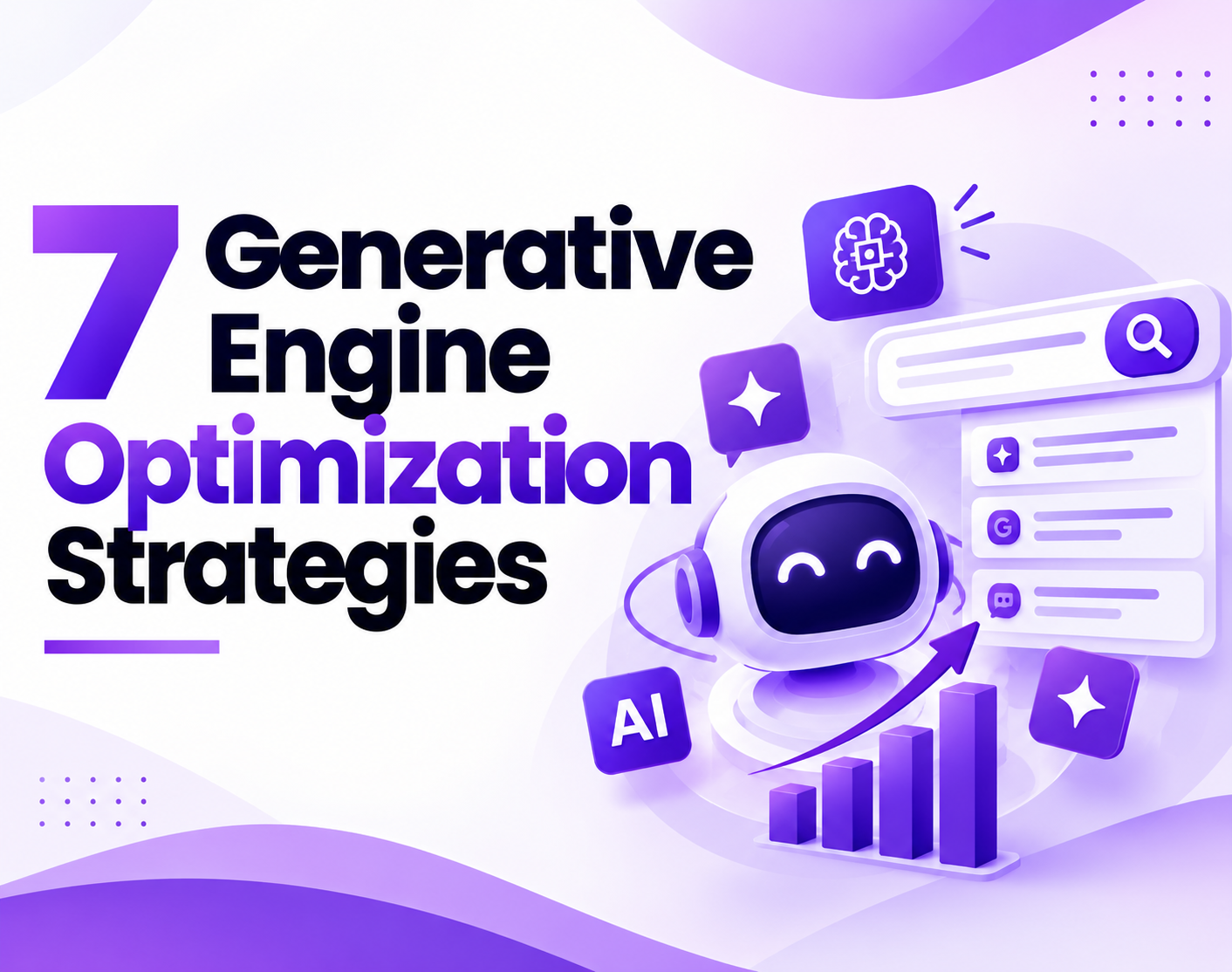
This is where Generative Engine Optimization (GEO) comes in. It focuses on making your content easier for AI search tools to find, understand, and reference in their answers.
But how do you improve your chances of being included in those answers?
This guide covers seven practical generative engine optimization strategies, each with an actionable step you can start implementing this week.
What Is Generative Engine Optimization (GEO)?
Generative engine optimization (GEO) helps your content get noticed by AI search tools. It makes your content easier for these tools to find, trust, and cite. It covers Google AI Overviews, ChatGPT, Perplexity, and Gemini.
The goal is simple. When someone asks an AI a question, your brand appears in the answer.
These tools use large language models. They write answers based on retrieved sources. Your role is to be one of those sources. Princeton researchers named this field in a 2023 paper, later presented at KDD 2024.
Why Does Generative Engine Optimization Matter?
Because people now get answers before they get links. Google says AI Overviews has over 2.5 billion monthly users. It says AI Mode has passed one billion.
When an AI answer satisfies the question, the click may never happen. The name inside the answer still sticks. That is the opportunity. It is also a risk. A brand that never gets named becomes invisible to people who never scroll.
If you’re a business owner in the UAE, this matters even more. Our guide on online marketing in UAE shows how many customers now start their search on AI and mobile before they ever visit a website.
How Does GEO Compare to SEO?
GEO and SEO share a common base. SEO helps pages rank, while GEO helps passages get quoted. Here’s a side-by-side comparison.
| SEO | GEO | AEO | |
| Goal | Rank pages | Get cited in AI answers | Win direct answers |
| Win looks like | A top ten link | A named source | A featured snippet or spoken answer |
| Content unit | The page | The passage | The answer block |
| Best proof | Backlinks and relevance | Stats, quotes, citations | Clear definitions |
Is SEO Dead Now With AI?

No. SEO is not dead. It is the floor that GEO stands on. If you want that floor built properly, our search engine optimization services cover the technical, on-page, and off-page basics that AI tools also rely on.
Google says the best practices for SEO still apply to AI Overviews and AI Mode. A page must be indexed and eligible to show with a snippet. Google also says no special schema is required.
So, is generative engine optimization a part of SEO now? Mostly, yes. GEO adds one job. Your content must work as a quotable answer, not only as a ranked page.
Honestly, at My Dedicated Marketers, we think most GEO advice is just SEO advice with a new label. Basics like good content, solid links, and a site people trust still do most of the work. If you skip them, AI tools won’t cite you. But there’s a small new layer too, like making your content easy to quote. Ignore that, and a competitor gets mentioned instead of you.
Think about the stakes. A page can rank and still lose the customer. The answer box already answered the question.
7 Generative Engine Optimization Strategies That Work
1. Lead With a Quotable Answer
Put a direct answer in the first 40 to 60 words under every heading. Then explain.
AI tools extract passages, not full pages. If your answer is in paragraph four, someone else could be quoted. Voice search works the same way. Assistants read just one clear answer aloud.
What to do:
- Write headings as real questions, the way people type or say them.
- Keep paragraphs to two or three lines.
- Add a short summary box near the top.
A weak answer: “Schema is a topic with many views.”
A strong answer: “Google says no special schema is required for AI Overviews. Standard structured data still helps it read your page.”
See the difference? One sentence you can quote. One you can’t.
Deeper dive: read our AEO guide.
2. Show Your Own Experience and Proof
Give AI something only you can offer: your own tests, data, and stories.
Anyone can rewrite a Wikipedia summary. Nobody can fake your Tuesday afternoon with a real client. That gap is your edge. It also lines up with Google’s E-E-A-T ideas of experience and expertise.
What to do:
- Run a small test. Ask ChatGPT, Perplexity, and Gemini the same 10 questions before and after you edit a page.
- Record who gets named. Publish the results in a simple table.
- Add an author bio with real credentials.
- Give your method a name so others can cite it.
This is where GEO for small businesses wins. A local bakery knows its customers. A giant brand can’t fake that. Share your case studies, your photos, and your numbers, the way we do in our portfolio. If you’re just starting out, our digital marketing guide for small businesses is a good place to begin.
3. Add Sources and Dates to Every Claim
Cite credible sources, and date every statistic.
The Princeton team tested nine ways to change content. Adding citations, expert quotes, and statistics raised visibility by up to about 40% in their tests. Keyword stuffing gave little or no benefit.
Here is the honest caveat. The team ran much of its testing on Perplexity. Treat the numbers as a strong hint, not a law.
What to do:
- Link to the original source, not a blog that copied it.
- Put the year next to each number.
- Delete any figure you can’t trace.
Many teams repeat one mistake. They paste a stat that was copied from a blog that copied another blog. Nobody checks. Then an AI repeats the error with your name on it.
For generative engine optimization for B2B, this matters most. Buyers check your numbers before they email you.
Want a second pair of eyes on your sources? Request a free AI visibility check.
4. Build Authority on One Topic
Cover one topic deeply, so AI links your brand to it.
Topical authority isn’t about publishing more. It is about covering the same subject so well that gaps vanish.
What to do:
- Build one pillar page and four to six supporting posts. Link them together. Use our topic cluster template.
- Name your brand, people, and products the same way everywhere. Consistency helps systems connect the dots, including the Knowledge Graph.
- Add one new supporting post each month. A solid content marketing strategy makes this easier to keep up.
This is the heart of a solid GEO marketing strategy. One brilliant post is a flare. A cluster is a lighthouse.
Read more about The Ultimate Guide to Building a Winning SEO Strategy
5. Make Your Site Easy for AI to Read
Remove technical blockers so crawlers can fetch and understand your pages.
Start with Google’s rule. A page must be indexed and eligible for a snippet. Schema markup is not required for that, but structured data like Article, Organization, and FAQPage schema helps machines read your page. See our schema markup guide.
Coverage of Google’s AI search guidance also calls two ideas myths. One is chopping content into tiny pieces. The other is rewriting pages in a special way for AI.
Ten minute checklist:
- Open robots.txt. Check that you aren’t blocking GPTBot or PerplexityBot by accident.
- Keep key text in plain HTML. Some crawlers struggle with heavy JavaScript.
- Check page speed and Core Web Vitals.
- Review Google Search Console. Google has begun testing a control that lets sites opt out of generative AI features. Don’t flip it by mistake.
Agencies can turn this list into a repeatable audit. That is the heart of generative engine optimization for agencies. Our technical SEO checklist gives you a start.
6. Get Mentioned on Trusted Sites
Get your brand named on third party sites that AI already trusts.
The Pew data shows where AI looks. Wikipedia, Reddit, and YouTube made up about 15% of sources in the summaries Pew examined, as reported by CNET. Government sites added another 6%.
What to do:
- Answer real questions on Reddit. Disclose who you are.
- Publish short explainers on YouTube.
- Pitch expert roundups and digital PR.
- Ask happy customers for reviews. Keep your Google Business Profile current.
- Run a citation gap check. List ten prompts. Note who gets cited, and where you are missing.
Don’t spam. Moderators spot it fast. So do readers. Steady, genuine activity on social platforms also helps. Our social media marketing services can help you build that presence.
7. Track Your AI Visibility and Improve
Measure how often AI names you, then improve what you learn.
What to do:
- Build a list of 20 to 25 priority prompts.
- Check them monthly in ChatGPT, Gemini, Perplexity, Copilot, and Google AI Overviews.
- Log three things: whether you are named, your citation position, and whether the description is accurate.
- Refresh your best pages every quarter.
One warning. AI answers change by user and by day. Run each prompt a few times and look for patterns, not single results.
Google says traffic from AI features counts inside the Web report in Search Console. A newer report for generative AI is rolling out to some sites. Pair it with Google Analytics and track AI share of voice in your own sheet. Our content refresh guide shows how to update pages fast.
Read more about 7 Best GEO Tools to Track and Improve Your AI Search Visibility
How to Use Generative AI for SEO?

Use it as a fast assistant, not a ghostwriter. Good jobs include keyword grouping, outlines, meta descriptions, schema drafts, and first pass edits. Then add what AI lacks: your data, your examples, and your judgment.
Speed is not an edge anymore. Everyone has it. Originality is the edge. See our AI content workflow.
What Generative Engine Optimization Strategies Are Working Well?
Based on published research, three lead the pack: citing sources, adding statistics, and adding expert quotes. Add strong SEO basics and off site mentions, and you cover most of the evidence.
Here’s the catch. Lab tests are not live results. Test on your own pages before you bet your budget.
Conclusion
These generative engine optimization strategies come down to one idea. Be the source worth quoting. Answer clearly. Prove it with firsthand work. Cite your sources. Build depth. Fix the technical basics. Earn mentions. Then measure and improve.
People will keep asking AI for answers. The question is whether your name comes back.
Want help? An AI search optimization consultant can audit your top ten pages and show you where AI skips you. Explore our full range of digital marketing services, check our pricing plans, or book a free consultation.
FAQs
How long does generative engine optimization take to work?
No one can promise a date. Google ranks pages on its usual schedule, and AI answers change often. Many teams review progress after about three months, because that gives enough prompts to compare. Treat any fixed promise with suspicion.
Do I need special tools to track AI search results?
No. A simple spreadsheet works to start, with Google Search Console added for AI feature traffic. Paid tools save time once you track at scale.
Which AI engines should I optimize for first?
Start with Google AI Overviews, because most sites already earn search traffic from Google. Then add ChatGPT and Perplexity. Better yet, ask five customers which tools they use. Optimize for those.
Can a small website get cited by AI?
Yes. The Princeton researchers reported that lower ranked sites gained the most from citing sources. Small sites win with narrow topics, firsthand proof, and clear answers. You don’t need a huge backlink profile to get quoted.
Does AI written content rank in AI search?
It can, but raw AI text rarely adds anything new. Google rewards helpful, original content, however it is made. Use AI for drafts. Then add your own data, examples, and edits.